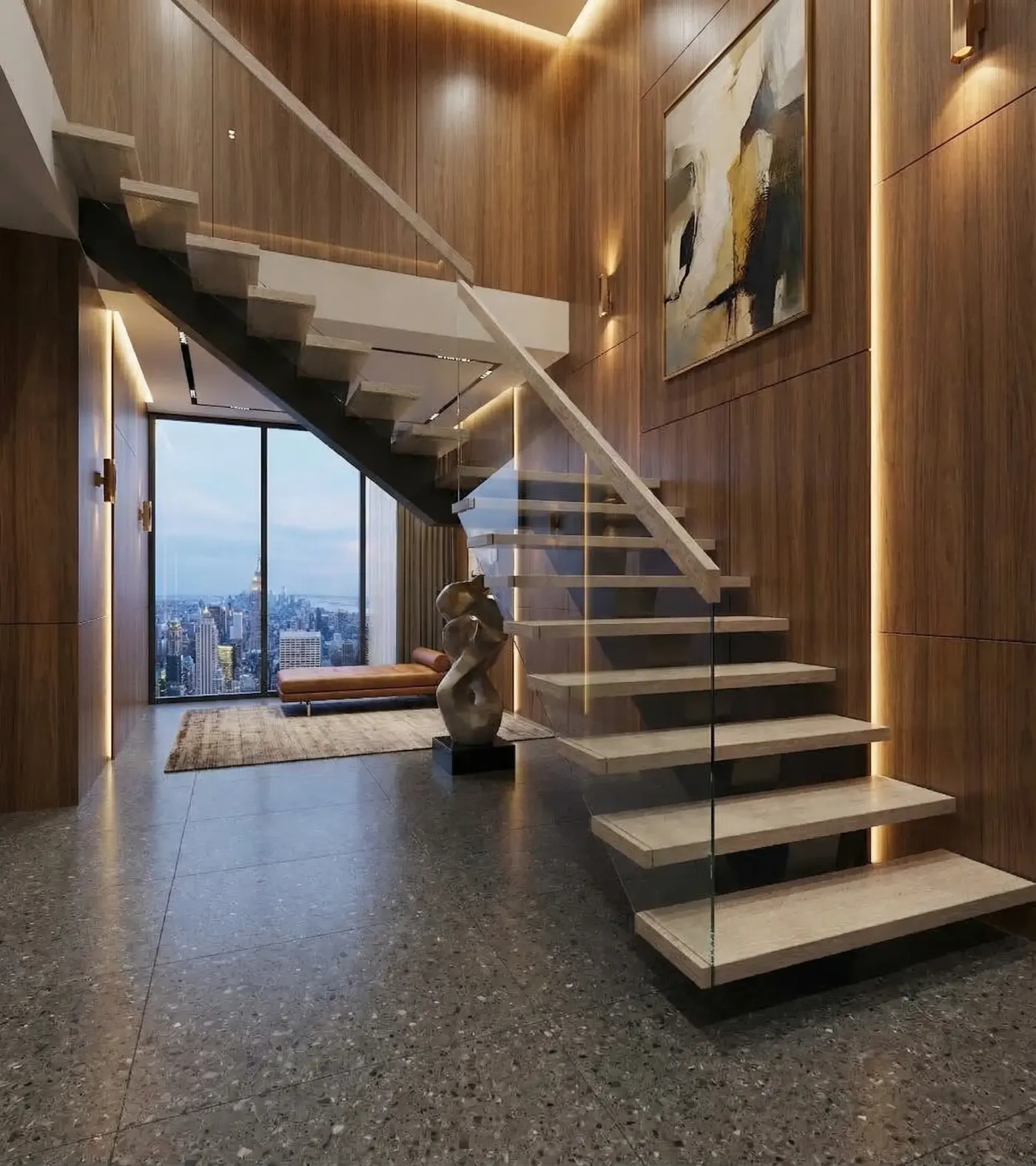
Laser-Cut Steel — The Structure Behind Every Floating Stair We Build
Every system we build uses a laser-cut steel structure fabricated in our shop. No on-site welding. No apparent welds. No adjustments cut in your home. The stair arrives finished and installs in a day.
At Hempstead Floating Stairs , every floating stair system we build uses a laser-cut steel structure. That structure is fabricated entirely in our shop to your exact field measurements. Nothing is cut on-site. Nothing is welded on-site.
The steel specification for all primary stringer and beam elements is ASTM A992 — the same grade used in structural wide-flange members for building construction. Consistent yield strength, tight chemistry tolerances, and predictable behavior under load. A lot of imported floating stair hardware is fabricated from lower-grade structural tube or plate with no certified mill test report. We specify A992 and require documentation, because on a cantilevered system where the steel is the only thing carrying the load, grade matters.
The reason there are no apparent welds on the finished structure is that all connections are made in the shop under controlled conditions, then finish-ground and powder-coated before the piece ships. The finish you see on installation day is the factory finish — no touch-up spraying in your home, no exposed weld marks, no rough edges.
Corrosion protection is layered for Long Island conditions. Interior steel receives a two-coat epoxy primer and finish system. Exterior and coastal applications — any Nassau County property within two miles of salt water — receive hot-dip galvanizing before the epoxy topcoat. Hot-dip galvanizing bonds zinc metallurgically to the steel surface; it can't be scratched off the way paint can. The epoxy overcoat adds a second barrier and provides the color and finish specification. This system typically delivers 25-plus years of corrosion resistance in coastal exposure, versus 5 to 8 years for painted steel alone in the same environment.
Connection to the building structure uses epoxy-set anchors drilled into the wall framing or concrete slab. In older Nassau County homes with wood-frame walls, anchor placement is coordinated with the framing layout confirmed during site assessment. Concrete applications — basement stairs in post-war Long Island ranches and split-levels with slab-on-grade lower levels — use Hilti HIT-RE 500 or equivalent epoxy rated for cracked concrete and freeze-thaw exposure per ICC-ES AC308.
Lead times on steel fabrication are longer than wood systems — typically 4 to 6 weeks from engineering approval to delivery. We set that expectation clearly at the start of the project so it doesn't conflict with your renovation schedule or move-in date.
Ready to get started?
We'll review your Nassau County project and provide a detailed proposal within 48 hours.
- ✓ Licensed & Insured in New York
- ✓ Nassau County Permit-Ready Documentation
- ✓ On-Time Completion Guarantee
- ✓ Site Assessment
How We Deliver Industrial Steel Beam Floating Stairs
Laser-Cut Steel Structure — FAQ
Why laser-cut steel for the structure instead of other fabrication methods?
Is hot-dip galvanizing necessary for interior steel stairs in Nassau County?
What steel grade do you use and why does it matter?
Can steel floating stairs be anchored into a concrete slab basement in a Long Island split-level?
How much does a laser-cut steel floating stair system cost in Nassau County?
Start Your Floating Stair Project on Long Island
Contact Hempstead Floating Stairs for a site assessment and detailed quote tailored to your Nassau County property.